Certificate In International Trade & Export Management provides students with the skills required to effectively manage and/or work in businesses or organizations involved in cross-border trading of goods in a global economy. This Certificate reflects the importance of understanding global trade and supply chain/logistics management and is built on foundational knowledge in international trade, global supply chain and logistics, and cross-cultural management skills.
Export-Import Management Course will empower the students to demonstrate expertise on the essential procedures, practices, and legislation of international trade finance and their readiness for career progression by enhancing their knowledge of the products, documents, trade terms, roles, and responsibilities that underpin international trade and finance.
This course:
Berkeley School of Business, Arts & Sciences - Headquartered in London, United Kingdom
Understanding International Trade Practices: Providing a comprehensive overview of international trade principles, regulations, and best practices.
Export Management Expertise: Training participants in export strategies, documentation, compliance, logistics, and risk management.
Market Entry Strategies: Helping participants analyze international markets and develop strategies for successful market penetration and expansion.
Regulatory Compliance: Ensuring familiarity with international trade laws, tariffs, customs regulations, and trade agreements.
Building Practical Skills: Developing competencies in negotiation, financial planning, and global supply chain management.
Promoting Economic Growth: Preparing individuals and organizations to contribute to international business expansion, economic growth, and sustainability.
This structure provides a comprehensive understanding of International Trade and Export Management across various strategic areas, ensuring that each day focuses on a key aspect.
International trade fosters economic growth by enabling the exchange of goods and services across borders, requiring an understanding of policies and regulations. Crises can disrupt trade by impacting supply chains and market demand, and analyzing these effects helps businesses adapt and find new opportunities. Export risk management focuses on assessing and mitigating risks through strategies like diversification and insurance, while the global value chain connects production stages worldwide, enhancing competitiveness and resilience in a globalized market.
Information and communication technologies (ICT) enhance international trade by improving efficiency in transactions, logistics, and communication through platforms like e-commerce and blockchain. Legal aspects, such as Incoterms and ISO standards, define responsibilities between buyers and sellers and ensure compliance with global regulations, ensuring safe and efficient trade. Export quality management focuses on maintaining high product standards and adhering to international regulations, building trust, and enhancing competitiveness in global markets.
Market research helps businesses understand market trends and consumer behavior to make informed decisions. Marketing management focuses on developing and executing strategies to promote products, ensuring effective market positioning. Production management oversees the manufacturing process, optimizing resources and ensuring quality to meet demand. Distribution management ensures efficient delivery of products through logistics and supply chain management, aiming for cost efficiency and customer satisfaction in both local and global markets.
International transportation management ensures the efficient and secure movement of goods across borders, optimizing logistics and complying with regulations. Export transactions cover the entire process of selling goods internationally, from negotiation to compliance, ensuring smooth operations and risk mitigation. Contract management involves creating and overseeing agreements between parties in international trade, ensuring compliance, managing risks, and protecting the interests of all involved in the trading process.
Costing and pricing involve determining production costs and setting competitive prices to ensure profitability in global markets. Export finance management focuses on securing funding, managing risks, and ensuring smooth payment processes for international trade. Effective communication and negotiation skills are crucial for building relationships, resolving conflicts, and securing favorable terms in cross-cultural global trade environments.
Berkeley offers expertly developed learning materials tailored to meet participants' needs, ensuring comprehensive coverage of the syllabus and optimal exam preparation.
‣ Tailored Material: Guides are designed to cover the entire syllabus, offering full preparation and deep understanding.
‣ In-Depth Content: Unlike superficial outlines, our materials provide fully developed theories and concepts, equipping participants with complete knowledge.
‣ Strategic Study: We help participants prioritize study time by indicating the weight of each topic, allowing efficient focus on crucial areas.
‣ Difficulty Levels: Topics are labeled as "Awareness" or "Proficiency," guiding participants to allocate time based on the required depth of knowledge.
‣ Comprehensive Coverage: Our materials include detailed theory and a glossary of technical terms to clarify complex concepts.
‣ Effective Learning Techniques: Visual aids and memorization techniques ensure long-lasting retention, helping candidates succeed.
Berkeley’s methodologies equip participants with the essential knowledge and tools for both exams and future success.
Our lecture plan integrates structured learning with interactive teaching methods, promoting engagement and collaboration. This approach ensures a comprehensive understanding of concepts, fostering critical thinking and practical application in real-world scenarios
Practice sessions offer hands-on experience through guided exercises, enhancing skills and reinforcing knowledge. This practical approach ensures mastery of concepts, promoting confidence and competence in real-world applications
Mock examinations simulate real test conditions, providing valuable practice and assessment. This helps identify strengths and weaknesses, ensuring thorough preparation and boosting confidence for actual exams
Evaluates and ensure the quality of the training program and all its deliverables. This is
measured through the following indicators:
‣ Instructors' experience and style in presenting and
explaining topics.
‣ Variety and balance of teaching methods (such as discussions, case studies,
mock exams and videos) used in the course to ensure retention and to match the learning
objectives.
‣ Level of interactivity.
‣ Feedback from program participants
‣ Full
compliance with Institute standards and guidelines for preparation and study requirements and
methodology.
‣ Progress reports from the training program provider.
Certificate in International Trade and Export Management supports career progression by offering practical and relevant assessments. Each unit is evaluated through realistic, work-related tasks designed to test knowledge, understanding, critical thinking, problem-solving, and actionable recommendations, ensuring intellectual rigor appropriate to the qualification level.
Assignments are structured around each unit's learning outcomes (LO) and assessment criteria (AC), requiring engagement with key theories underpinning the subject.
Learners must reference real organizations to illustrate their answers, supported by case studies and in-company opportunities for research, investigations, or task support. Mature and part-time learners are encouraged to draw on their professional experience to enhance their learning.
Ideal for disciplined learners who prefer flexibility
Learn from expert instructors in real-time
Personalized, intensive learning experience
“As a strong advocate for education and human development, I commend Berkeley for its exceptional commitment to empowering future leaders. The institution stands as a symbol of excellence, innovation, and opportunity. Students who walk its halls are nurtured with knowledge, values, and vision—qualities that contribute to building a stronger and more prosperous future for our nation.”- H.H. Shaikh Khalifa Al Hamid
‣ Exclusive Networking Events: Access invitations to industry-leading events and thought-leadership gatherings featuring renowned speakers.
‣ Monthly Updates: Stay informed with a newsletter highlighting the latest research, events, and activities from the school.
‣ LinkedIn Community Access: Join the Executive Education LinkedIn group for networking and professional development opportunities.
‣ Educational Discounts: Enjoy a 20% discount on open-enrollment programs and access to workshops focused on emerging trends.
‣ Global Alumni Network: Connect with a diverse alumni community through the Berkeley School’s online network and engage in country and interest groups.
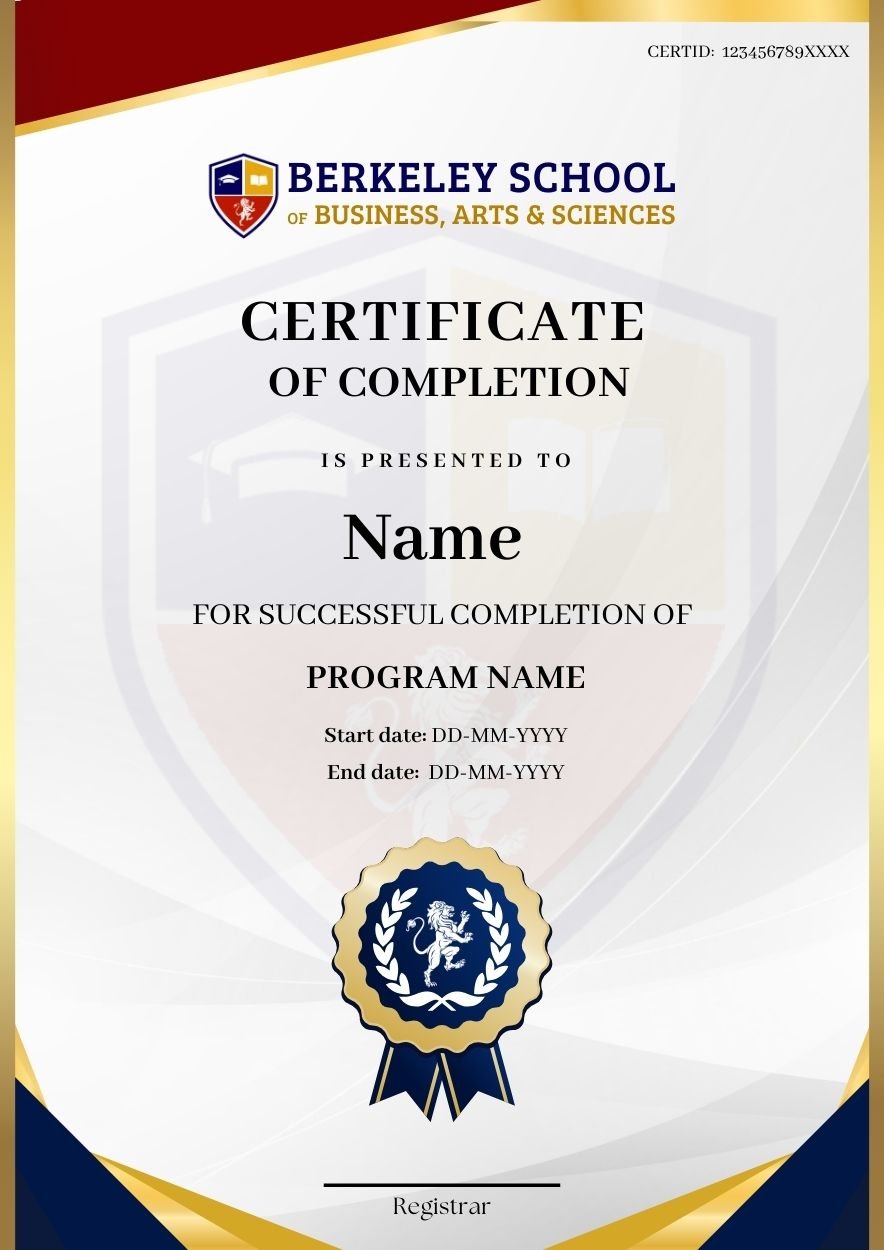
You will get a certificate of completion, which is highly reputed and accepted by employers.
Ability to manage export transactions, navigate legal frameworks (e.g., Incoterms, ISO), and mitigate risks associated with cross-border trade.
Proficiency in transportation management, production planning, and distribution strategies to ensure the efficient flow of goods across borders.
Ability to analyze markets, develop competitive pricing strategies, and optimize supply chains for global business expansion.