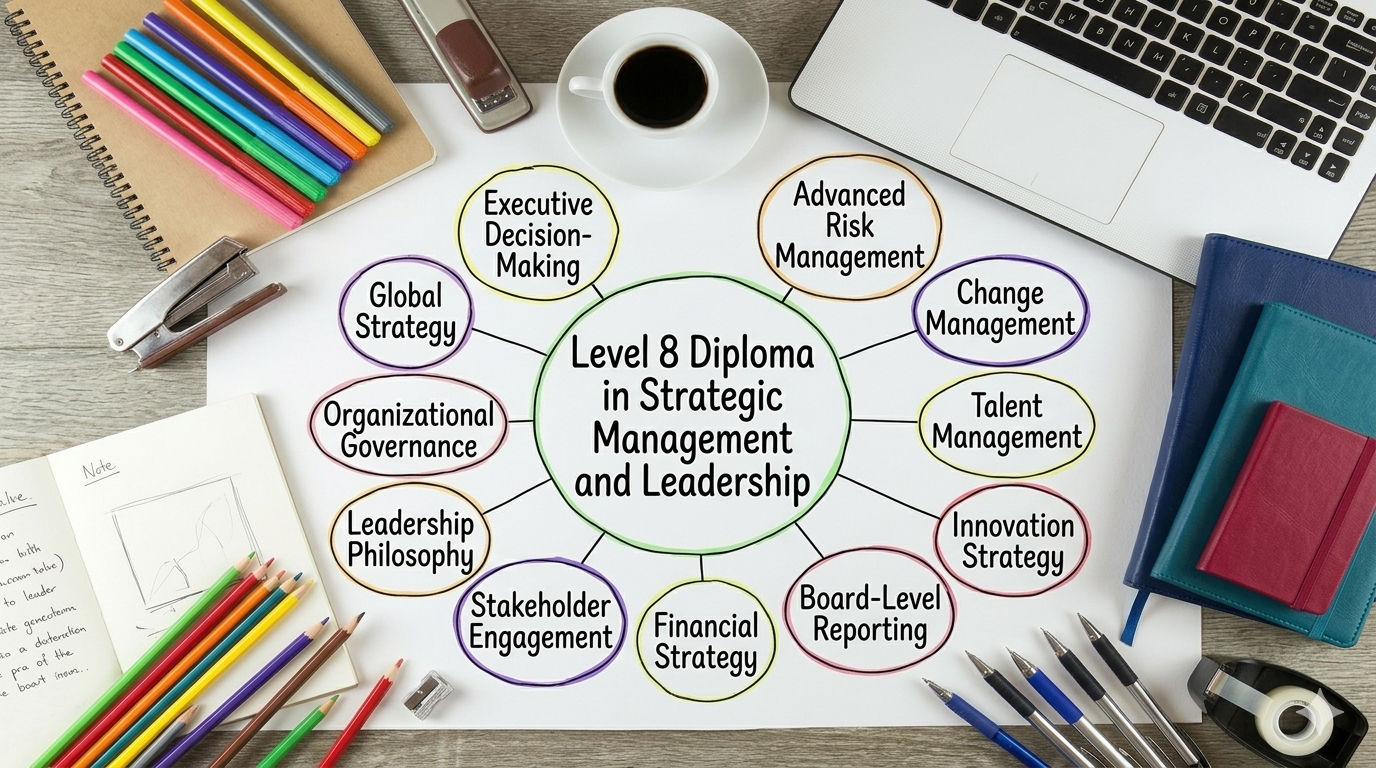
This Level 8 Diploma is designed to develop and implement effective strategies within ambitious and growing organizations. Strategic management is intended for executive directors and senior managers, as well as professionals with the authority and vision to translate organizational strategy into strong corporate performance.
The diploma is designed for aspiring or current directors and senior managers to develop a strong understanding of strategic direction and leadership, with a focus on driving organizational growth and performance. It addresses key areas of business development, particularly in organizational and strategic management, marketing, and enterprise, while evaluating contemporary industry issues to provide both vocational insight and academic perspective.
The qualification supports learners in becoming independent and self-directed, equipping them with the tools and motivation to continue learning, developing, and reflecting on their professional practice throughout their careers. It aims to enable learners to apply analytical and evaluative techniques within both private and public sector organizations, enhance critical thinking across diverse industries, and strengthen their ability to reflect on personal learning and development. Additionally, it encourages the development of self-reflection, intellectual capability, and transferable skills essential for effective leadership and career progression.
Berkeley School of Business, Arts & Sciences
To develop visionary leaders capable of driving organizational strategy and achieving sustainable growth, while delivering a high-quality learning experience that builds expertise in strategic management, leadership, and decision-making, enabling professionals to lead at executive level, implement effective corporate strategies, and enhance organizational performance in global business environments.
Learners are expected to hold a Level 7 postgraduate qualification or a master’s degree. Entry is typically based on an interview process conducted by the training provider. Applicants whose first language is not English must demonstrate English language proficiency, such as IELTS 6.0 or equivalent. International qualifications will be assessed to ensure they meet the requirements for entry into UK postgraduate-level programmes.
The Level 8 Diploma in Strategic Management and Leadership comprises eight mandatory units, totaling 160 credits, 1,600 Total Qualification Time hours and 640 Guided Learning Hours. Seven units are at Level 8, while Research Methods is at Level 7. Each unit carries 20 credits.
Examine the relationship between strategic leadership and management. Learners evaluate leadership qualities, management styles, organizational values and approaches for improving team performance and strategic outcomes.
Strategic Management and Leadership
Vision, Mission, Values and Ethical Leadership
Transformational, Transactional and Situational Leadership
Team Performance and Organizational Direction
Develop the strategic leadership capabilities required by directors and senior managers working with international partners, customers, suppliers and competitors. Learners assess their skills and create a structured leadership-development plan.
Strategic Leadership Skills and Competencies
Personal Leadership Development Planning
Plan Implementation, Review and Improvement
Leadership Impact on International Organizations
Explore strategy development for organization operating across national and international boundaries. Learners examine political, ethical, social, religious and cultural influences while developing collaborative and evidence-based strategies.
Cross-Border Strategy Formulation
Political, Social, Cultural and Ethical Influences
Collective Strategy and Stakeholder Collaboration
Strategic Intelligence and Conflict Management
Examine how global influences affect strategic planning, implementation and organizational risk. Learners evaluate inter-organizational strategies, strategic intelligence and cultural differences in international decision-making.
Inter-Organizational Strategy Planning
Strategy Formulation and Operational Outcomes
Strategic Intelligence and Risk Management
Cultural Differences in Global Planning
Evaluate the factors influencing international organizational policy and strategic direction. Learners examine stakeholder relationships, economic drivers, funding, operational implementation and methods for anticipating future strategic change.
Policy and International Strategic Direction
Stakeholder Relationships and Governance
Economic Drivers, Finance and Funding
Strategic Forecasting and Innovative Solutions
Assess the influence of domestic and international media on organizational strategy. Learners evaluate stakeholder opinion, political groups, media ownership and communication methods that support positive strategic outcomes.
Media Influence on Organizational Strategy
Stakeholders, Pressure Groups and Media Ownership
News, Public Opinion and Corporate Reputation
Global Media and Integrated Communication Strategy
Develop an advanced understanding of how culture influences international organizations and strategic decisions. Learners examine political, religious, social and geographical factors alongside stakeholder power and organizational relationships.
Culture and International Strategy
Political, Religious and Social Influences
Cross-Cultural Strategic Decision-Making
Stakeholder Power, Status and Strategic Change
Develop the academic and practical research skills required to investigate business and management issues. Learners formulate research questions, review literature, select methodologies, analyze data and prepare ethical research reports.
Qualitative and Quantitative Research Methods
Research Questions and Literature Reviews
Research Design, Data Collection and Analysis
Research Reporting, Data Visualization and Ethics
Berkeley offers expertly developed learning materials tailored to meet participants' needs, ensuring comprehensive coverage of the syllabus and optimal exam preparation.
‣ Tailored Material: Guides are designed to cover the entire syllabus, offering full preparation and deep understanding.
‣ In-Depth Content: Unlike superficial outlines, our materials provide fully developed theories and concepts, equipping participants with complete knowledge.
‣ Strategic Study: We help participants prioritize study time by indicating the weight of each topic, allowing efficient focus on crucial areas.
‣ Difficulty Levels: Topics are labeled as "Awareness" or "Proficiency," guiding participants to allocate time based on the required depth of knowledge.
‣ Comprehensive Coverage: Our materials include detailed theory and a glossary of technical terms to clarify complex concepts.
‣ Effective Learning Techniques: Visual aids and memorization techniques ensure long-lasting retention, helping candidates succeed.
Berkeley’s methodologies equip participants with the essential knowledge and tools for both exams and future success.
Our lecture plan integrates structured learning with interactive teaching methods, promoting engagement and collaboration. This approach ensures a comprehensive understanding of concepts, fostering critical thinking and practical application in real-world scenarios.
Practice sessions offer hands-on experience through guided exercises, enhancing skills and reinforcing knowledge. This practical approach ensures mastery of concepts, promoting.
Mock examinations simulate real test conditions, providing valuable practice and assessment. This helps identify strengths and weaknesses, ensuring thorough preparation and boosting confidence for actual exams.
Evaluates and ensure the quality of the training program and all its deliverables. This is measured through the following indicators:
‣ Instructors' experience and style in presenting and explaining topics.
‣ Variety and balance of teaching methods (such as discussions, case studies, mock exams and videos) used in the course to ensure retention and to match the learning objectives.
‣ Level of interactivity.
‣ Feedback from program participants
‣ Full compliance with Institute standards and guidelines for preparation and study requirements and methodology.
‣ Progress reports from the training program provider.
“As a strong advocate for education and human development, I commend Berkeley for its exceptional commitment to empowering future leaders. The institution stands as a symbol of excellence, innovation, and opportunity. Students who walk its halls are nurtured with knowledge, values, and vision, qualities that contribute to building a stronger and more prosperous future for our nation.”- H.H. Shaikh Khalifa Al Hamid
Alumni Benefits
‣ Exclusive Networking Events: Access invitations to industry-focused events and leadership sessions featuring experts in strategic management and leadership.
‣ Monthly Updates: Stay informed with newsletters covering the latest insights, research, and developments in business strategy and leadership.
‣ LinkedIn Community Access: Join a professional LinkedIn group to network, collaborate, and explore opportunities in senior management roles.
‣ Educational Discounts: Enjoy a 20% discount on advanced leadership programmes and professional workshops to support continuous development.
‣ Global Alumni Network: Connect with a diverse international alumni community, engaging with professionals across industries in strategic management and leadership.
The Level 8 Diploma in Strategic Management and Leadership is aligned with doctoral-level standards in the UK and supports career progression into executive and board-level leadership roles. Salaries for professionals vary based on experience, industry, and organizational scope, with strong earning potential across senior leadership positions in the UK market.
United Kingdom (Primary Market Focus)
Salary Range: £80,000 – £180,000+ per year
Average Salary: £100,000 – £140,000 per year
Professionals with this qualification typically progress into roles such as Chief Executive Officer (CEO), Managing Director, Director of Operations, Strategic Director, and Senior Business Consultant, where compensation increases with executive responsibility, organizational impact, and strategic decision-making authority.
After completing the Level 8 Diploma in Strategic Management and Leadership, learners can progress to doctoral-level qualifications such as a Doctor of Business Administration (DBA) or PhD programmes. This advanced qualification provides learners with the strategic knowledge and research capabilities required for the highest levels of academic and professional development, supporting entry into doctoral studies with advanced standing.
You will receive a Level 8 Diploma in Strategic Management and Leadership, a globally recognized qualification valued by employers across industries.
Applicable across industries including finance, healthcare, consulting, technology, and corporate sectors.
Opens pathways to senior management and leadership roles, supporting career growth and promotion opportunities.
Contact Us